

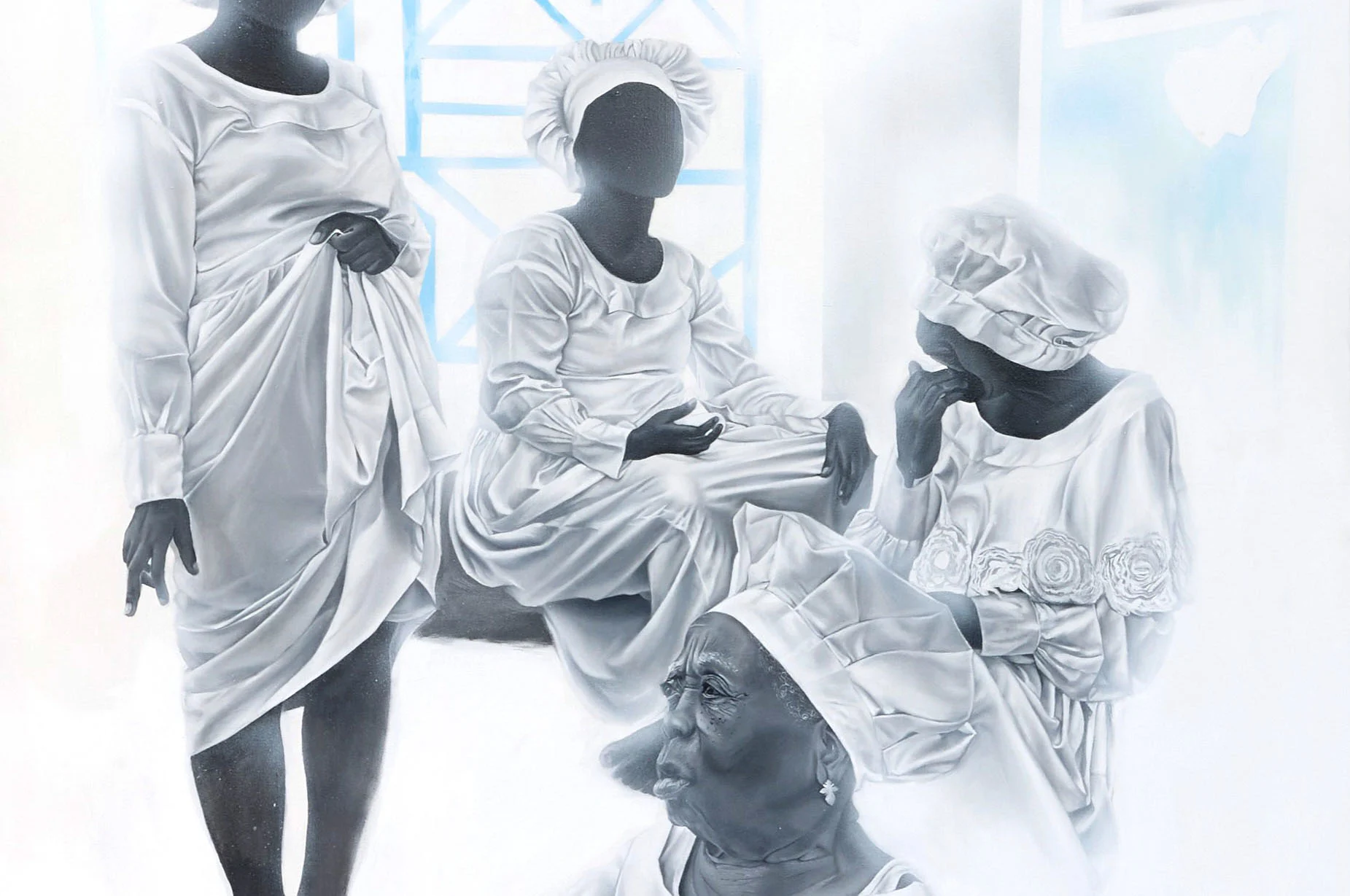
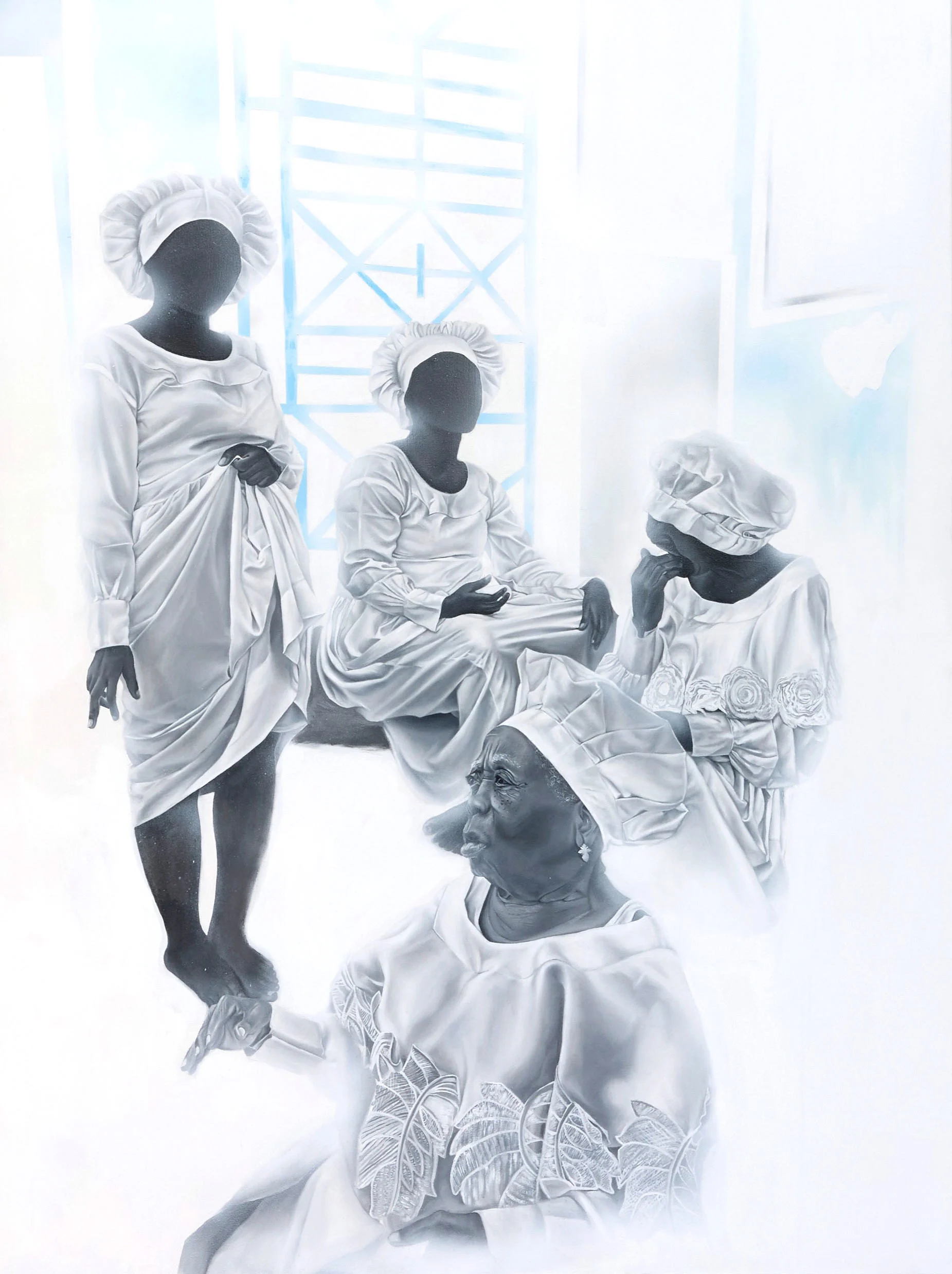
In her monochrome paintings of the Celestial Church of Christ, Elizabeth Omotosho uses light, depth and shadow to render what cannot quite be seen: the interior lives of women whose faith is both communal and irreducibly private. She tells Yasmin Alrabiei how creating this series allowed her to better understand and express her experiences in the church she was born into, and to finally begin closing the distance between her experience of it and the understanding of others.
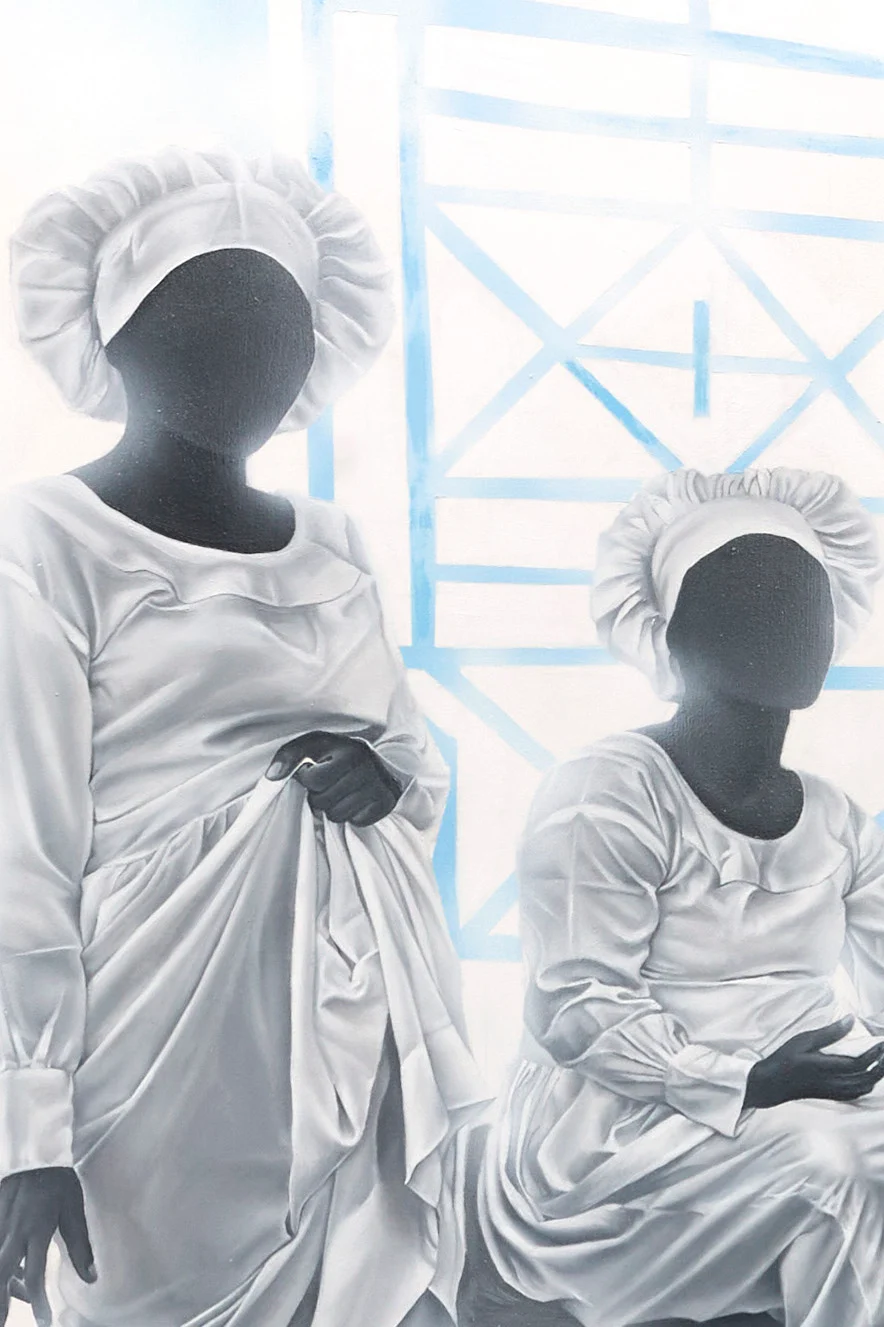
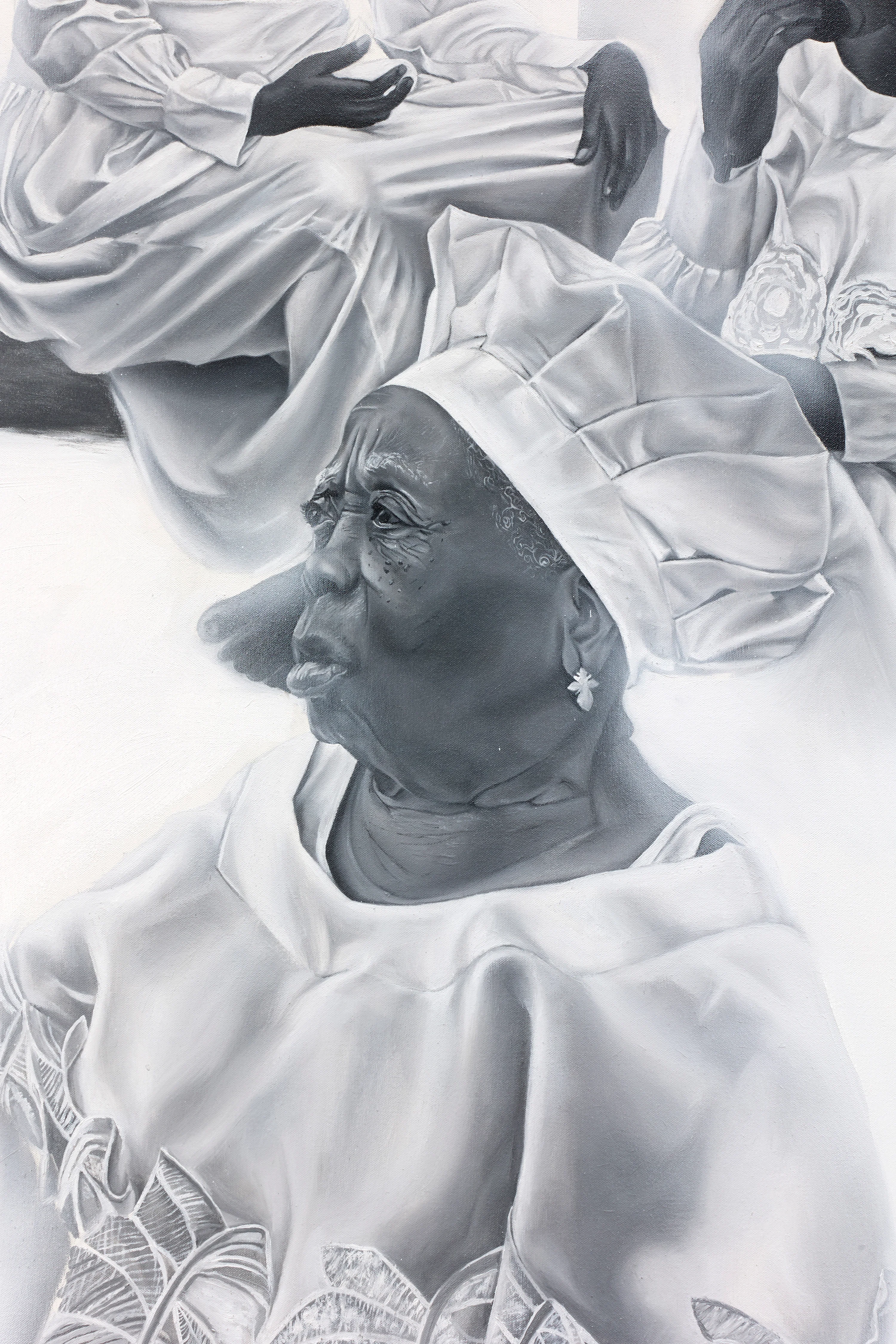
“Ẹ ṣí ọkàn yín sílè” is a Yoruba phrase that translates roughly to “open your hearts,” and it is also the title of Elizabeth Omotosho’s latest series, in which women become embodiments of this willed vulnerability, their bodies and gestures suspended between revelation and concealment. Across large-scale oil and spray paint works depicting women within and around the spaces of the Celestial Church of Christ, Omotosho does not so much illustrate faith as make its effects palpable.
The services, prayers and sense of community gave me a strong spiritual foundation from an early age. At the same time, I experienced moments of questioning and reflection, especially around identity.
Like an eternal pendulum between the personal and the public, faith has always swung between liturgy spoken aloud in a room full of people, to then be followed by a private reckoning that takes place after the service ends. Omotosho understands this duality, the coexistence of two entry channels to the Holy that don’t need to be resolved into one. Her figures are at once communal and unreachable, and they’re surrounded by light. With oil and spray each woman depicted emanates an opaline safety that also edges supernatural. “From my own experiences and memories, when I imagine a place or a moment, I often see blank white spaces surrounding it,” she says. “Those spaces become a way of visualizing things that cannot be fully seen or explained. They create a sense of peace, while also holding feelings of uncertainty and insecurity.”
The Celestial Church of Christ hovers at a threshold too. Founded in 1947 in Porto-Novo, Republic of Benin, by Samuel Bilehou Joseph Oshoffa following a divine vision, the CCC grew from a single service held beneath a tree into one of the most widely distributed African-instituted churches in the world, with parishes across Africa, Europe and North America. It belongs to the Aladura movement, a stream of West African Christianity shaped as much by prophetic and visionary experience as by biblical scripture. What distinguishes the CCC theologically is precisely what makes it culturally rich and, for some, contentious: its cosmology is, in the assessment of scholar Afe Adogame, “a synthesis of biblical belief, Christian liturgical tradition, and elements from the Yoruba cultural milieu and worldview.”
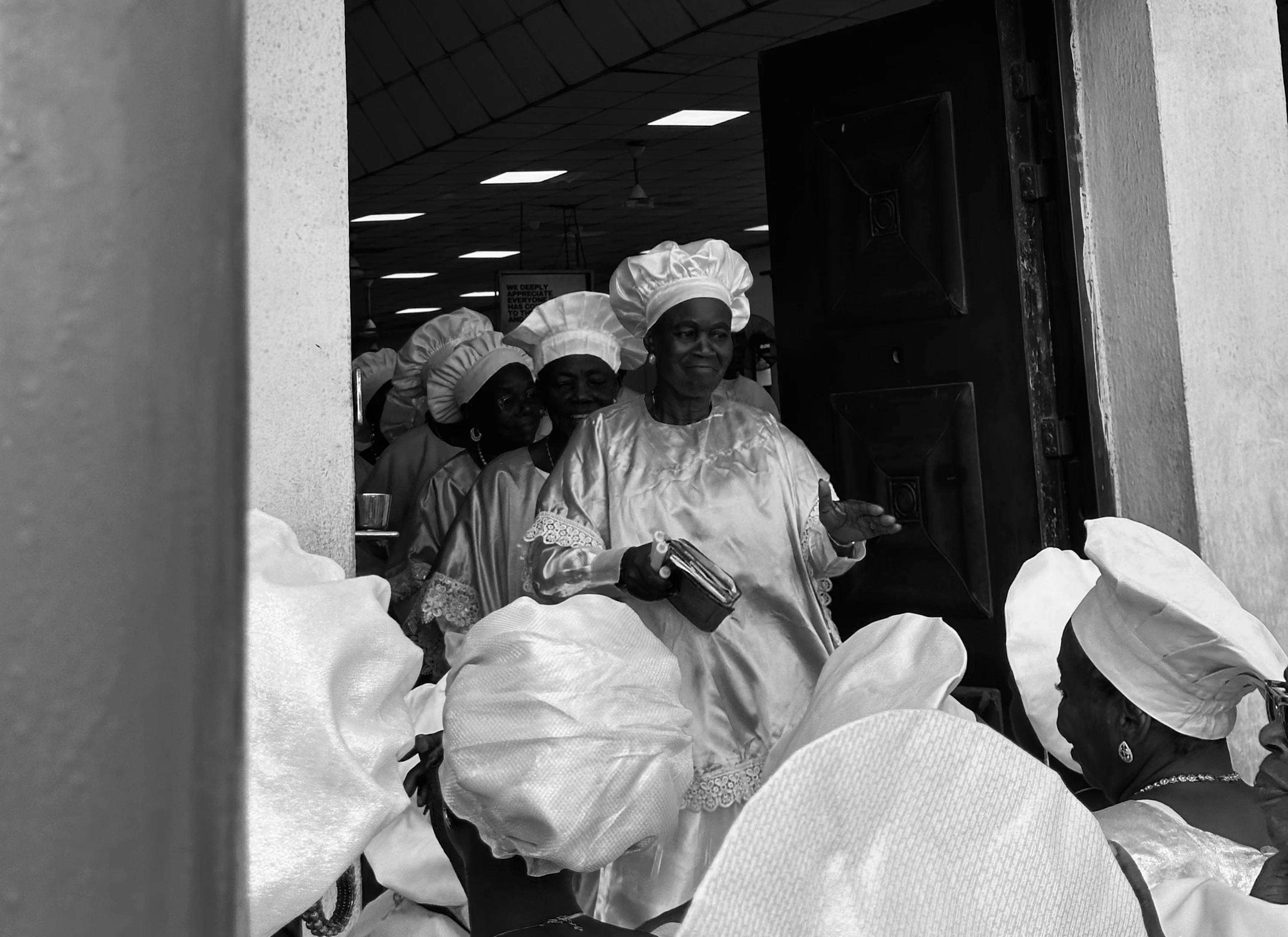
“There are different perspectives on this,” Omotosho says. “Some people see African Christianity as a continuation of European missionary Christianity, while others believe African churches have transformed Christianity into something distinctly African, shaped by local histories, spiritual practices and worldviews.” The church maintains, officially, that it is a Christian institution of its own kind, and refuses any direct connection to traditional religious thought. Yet its ritual vocabulary—the use of white garments as sacred attire, emphasis on prophecy and visions, practices of spiritual healing and protection—resonates unmistakably with cosmological frameworks that preceded Christianity’s arrival in West Africa.
“Growing up in the Celestial Church of Christ,” Omotosho reflects, “I never saw these things as separate. They were simply part of how faith was lived, experienced and understood within my community.” This is the phenomenology that her paintings inhabit—it is lived reality. Scholars have noted that Yoruba cosmology shaped the CCC’s very construction of sacred space, and that both worldviews share belief in the reality of benevolent and malevolent spiritual forces operating within and around human life. Omotosho paints from inside it, where it has never needed explanation.
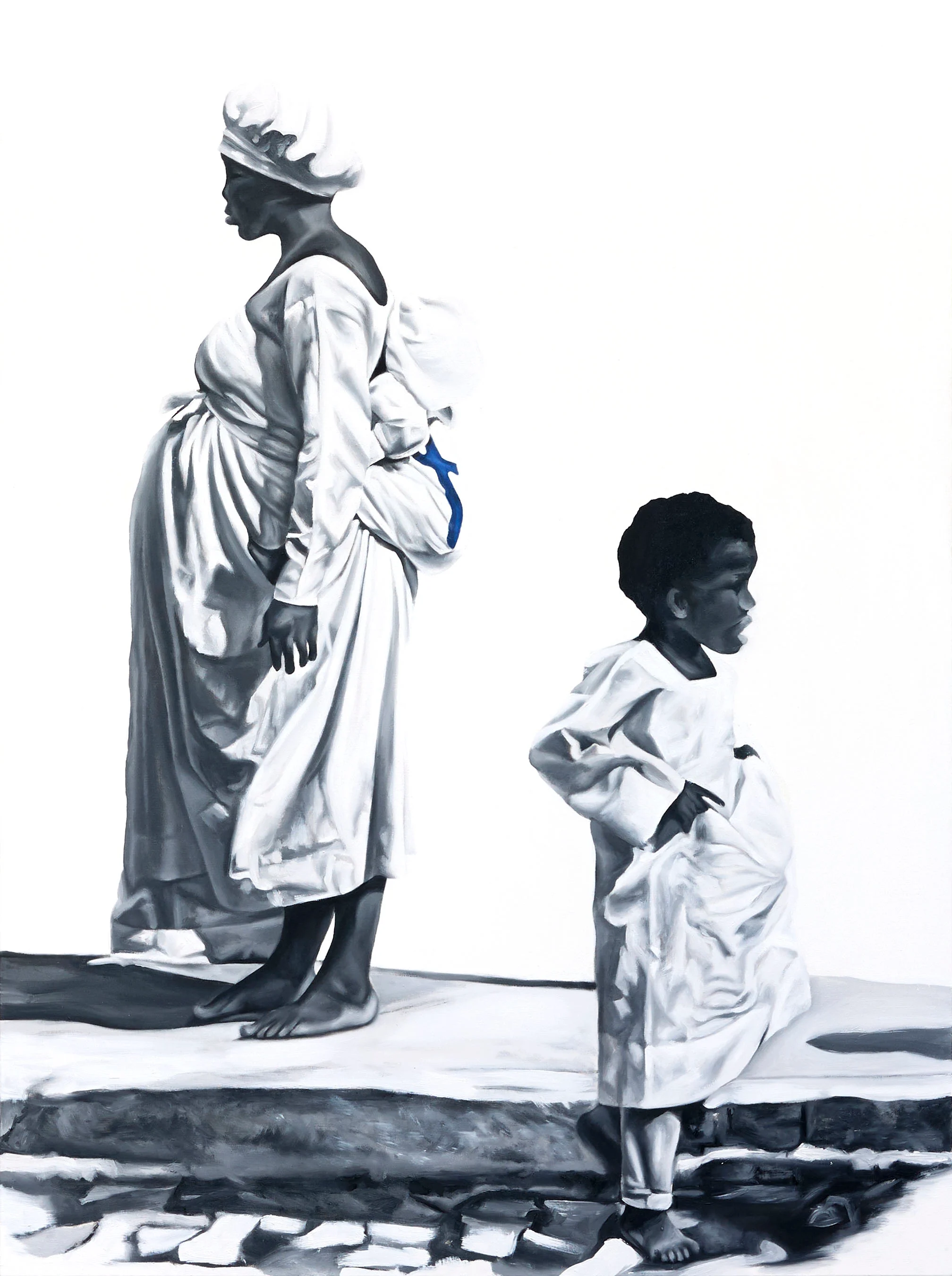
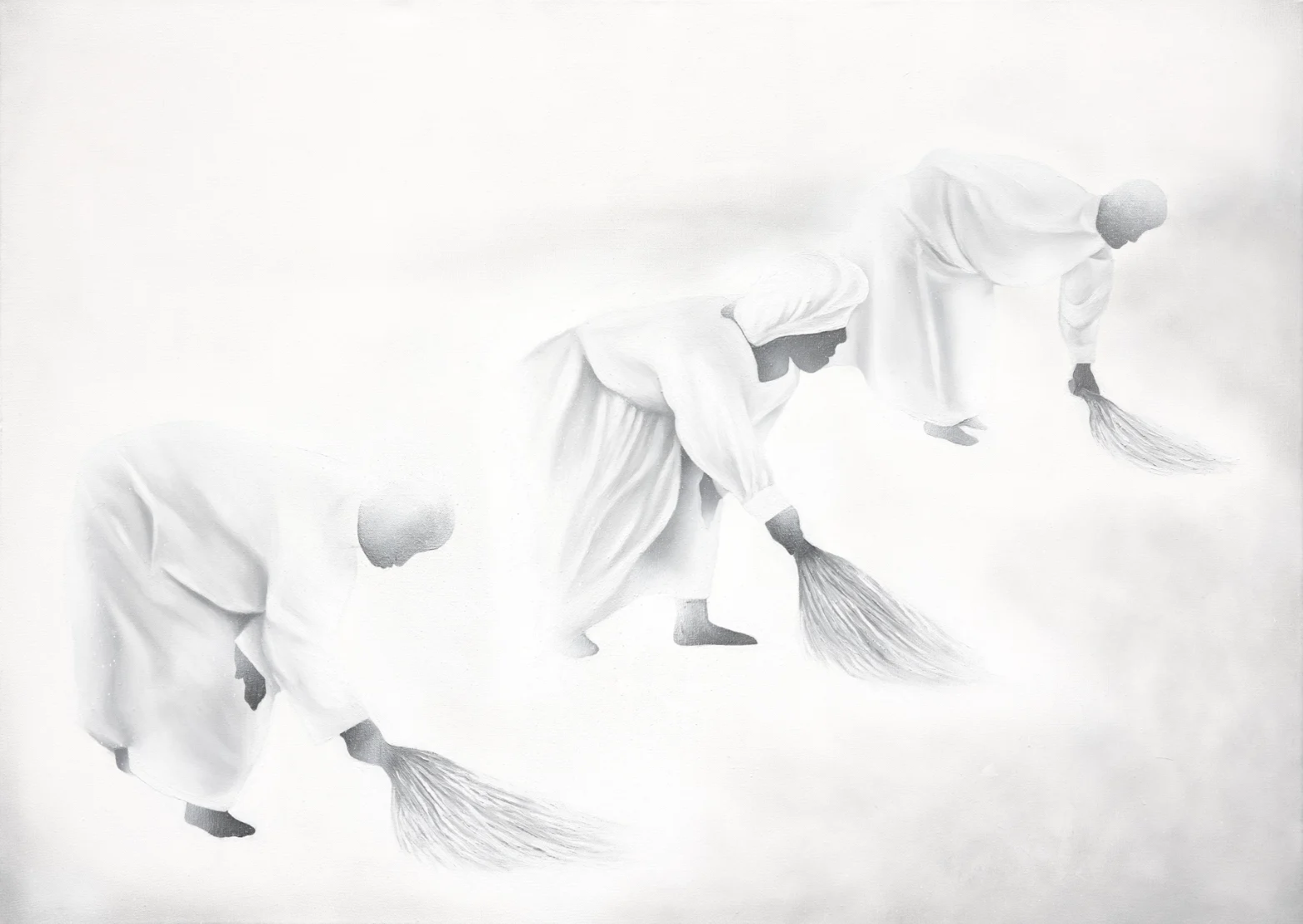
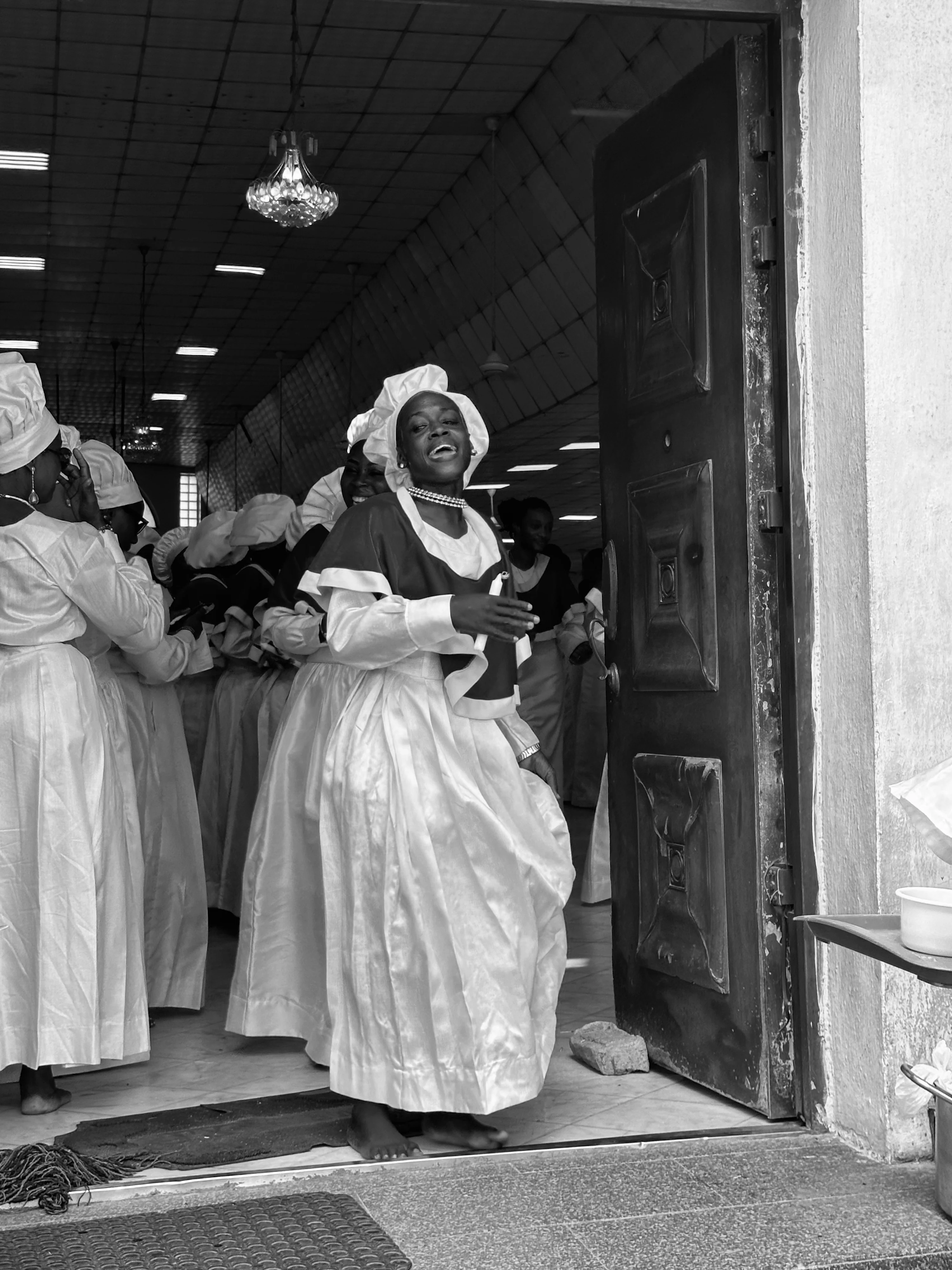
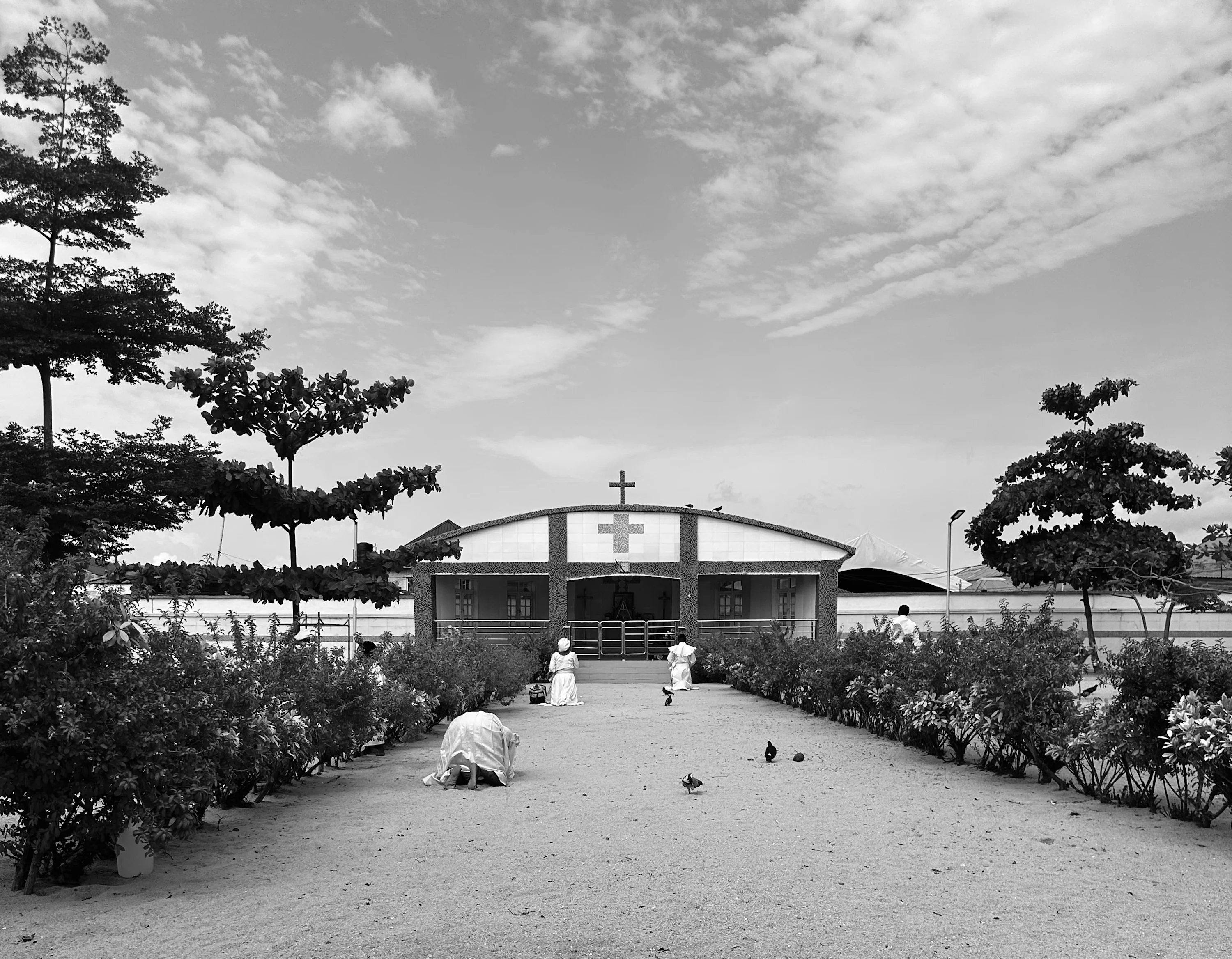
Like most things that are traced back to the private and personal, the series began with a visit to her grandmother’s church at the CCC Archdiocese in Makoko, Lagos. Omotosho took photographs and began “imagining other narratives and possibilities within the scenes,” paying attention to gestures, facial expressions and body language; the visual data through which interior experience leaks into the visible world, changing it in the process.
The profound spiritual agency that women exercise within the faith; through prayer, prophecy, organising and the sustaining of community across generations are honored in Omotosho’s work. “The blank faces and gestures communicate strength, power and freedom,” she says. “They create a space for reflection, allowing viewers to consider their own interpretations and connections to the figures.”
Painting became the only way for me to truly express those emotions and experiences.
The surfaces of Omotosho’s paintings are alive; oil and spray paint layer against each other, creating a grain that catches the eye differently at different distances, like the way a hymn heard from the back of a church sounds before its words become distinguishable. Omotosho has spoken elsewhere about painting as a process of constant discovery, and that quality of genuine not-knowing is palpable in the work. It feels well-suited given that light and shadow conceptually permeate so much of how we understand devotion.
We discuss how knocking on the door of our beliefs with curiosity is its own act of faith. “The services, prayers and sense of community gave me a strong spiritual foundation from an early age,” Omotosho says. “At the same time, I experienced moments of questioning and reflection, especially around identity, belonging and how faith is practised across different cultures and generations.” Questioning, as Omotosho’s experience suggests, does not loosen faith so much as locate it. Most religions are born from that place of seeking and subsequent revelation. What is examined and returned to becomes a choice rather than an inheritance, and that distinction changes everything.
There is something important in the fact that the act of painting too, for Omotosho, is a form of spiritual practice. Kerry James Marshall’s observation that Black figures in painting can be read “like characters in a play or documentary” influenced how she approaches choreography of the body, but the impulse driving the work is more intimate than that. It is the impulse toward expression in the face of inexpressibility. For years, she explains, she felt unable to speak openly about her denomination, conscious that explanation would not fully close the distance between her experience and others’ understanding. “Painting became the only way for me to truly express those emotions and experiences,” she says. In this sense, each canvas in “Ẹ ṣí ọkàn yín sílè” is both image and the journey that got us here, beholding it. A public offering, made from something too personal for words, asking the viewer to open their hearts.