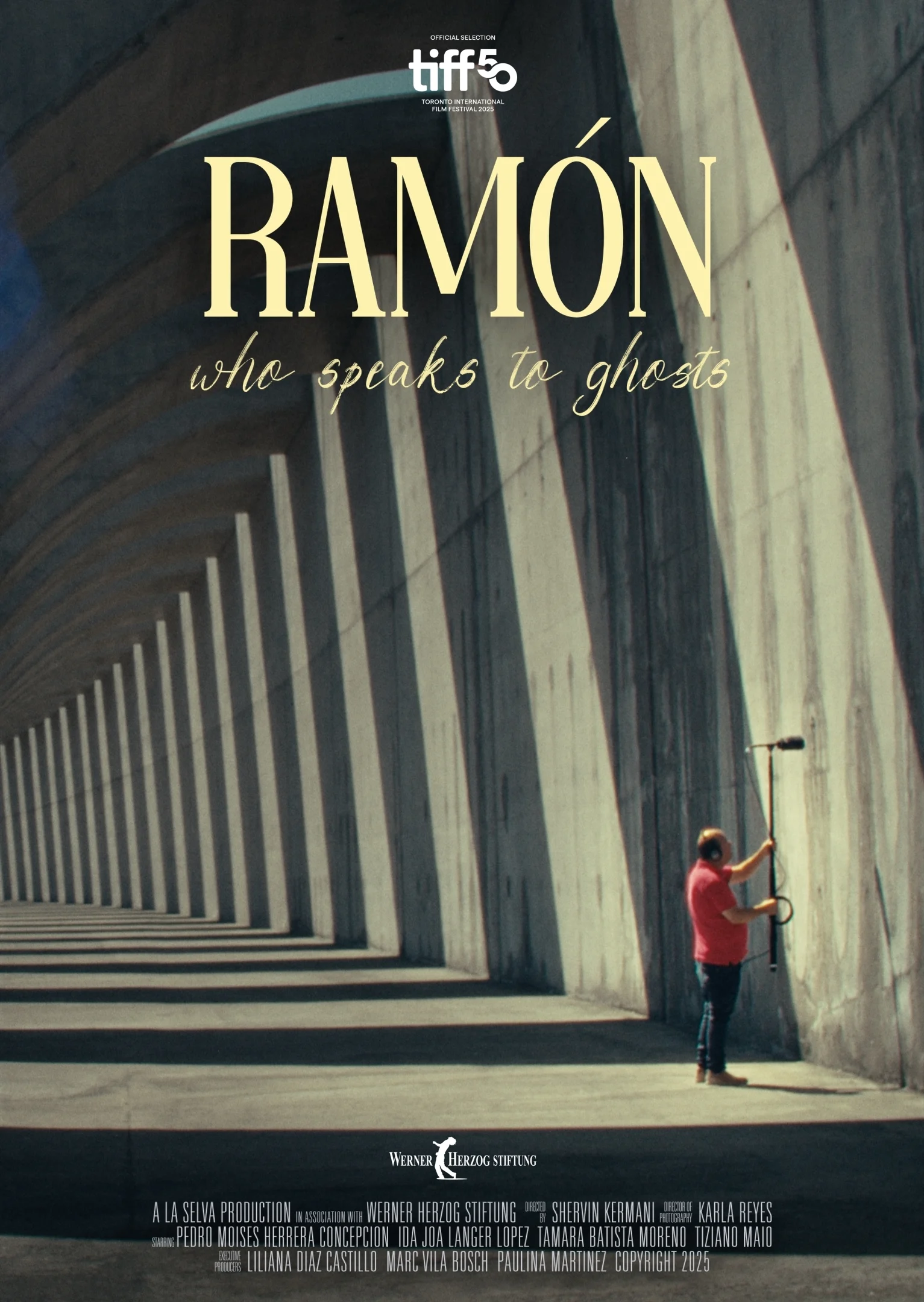
When filmmaker Shervin Kermani arrived on La Palma in 2024, it had been three years since the Cumbre Vieja volcanic eruption destroyed homes and community spaces on the island. In his short docufiction film, “Ramón Who Speaks to Ghosts,” we meet a man who spends his days communicating with spirits, with local actor Pedro Moisés Herrera Concepción drawing on his own grief, and the collective pain of the island, to play the role. Kermani tells Neelam Tailor how he merged fiction with the real stories of the people he met to tell a story about the everyday moments that are lost in the wake of tragedy.
Ramón can’t understand why his friend Marcelo still smokes. He’s a ghost after all. What use could he have for a cigarette without lungs? Elsewhere on the charcoal-grey shores of La Palma, ghosts play volleyball and sunbathe. Ramón finds the latter particularly ridiculous. Looking at an empty towel on the black sand, he laughs: “And then I’m the crazy one.”
There’s something so genuine about Ramón that you almost forget to question him. He could be someone a filmmaker happened upon, keen to introduce a visitor to his invisible friends. Gradually, Shervin Kermani’s “Ramón Who Speaks to Ghosts” reveals itself as something between documentary and fiction, and as we fall in love with Ramón, we begin to understand what these encounters mean on an island where the 2021 volcanic eruption buried homes and community spaces beneath lava.
The grief underneath his charisma would come out every time we spoke about the volcano.
Iranian-Canadian filmmaker Kermani arrived on La Palma in September 2024, three years after the volcanic eruption, for La Selva’s 10-day film accelerator led by Werner Herzog and cinematographer Peter Zeitlinger. Herzog had instructed participants to come without preconceived ideas. “And I rather unintelligently actually listened to this instruction,” Kermani laughs. Once there, he remembers thinking: “Ugh, I should have written the whole script.”
Their theme was “after the fire.” Watching fellow filmmakers gather around a resident showing them her house, Kermani had another thought: “gosh, we’re all gonna make the same film.” One of his early attempts involving a woman miming dinner preparations in a ruined kitchen wasn’t quite working. But while scouting the lava fields, Kermani found himself imagining a man searching for ghosts. He already had a microphone, a boom pole and headphones. “I just had a gut feeling that I needed to kind of follow this image,” he says. Alongside him was co-writer and cinematographer Karla Reyes, who also translated on set.
Local actor Pedro Moisés Herrera Concepción, who plays Ramón, caught his attention through a casting video. Speaking to him, Kermani sensed “grief underneath his charisma that would come out every time we spoke about the volcano.” Pedro described a café he used to visit, now buried, and the sound of the people he missed hearing there. “It really struck me,” Kermani says. “This idea of missing sounds.”
Kermani wanted us to enjoy Ramón’s company before discovering what he had lost. “If you’ve had a chance to fall in love with this character, the tragedy could catch you by surprise in the second half of the film and kind of reveal the catastrophic subtext of this strange obsession,” Kermani says.
Playful bursts of classical music punctuate these little moments where Ramón translates for us all the stories of ghosts he’s hearing. There’s something of “Amélie” in the way we get to know him through how he perceives others, and the beautiful poetic detail of his descriptions—a pirate speaking of his lover, or an aboriginal ghost called Benahoarita who has been “angry for centuries.”
Trying to cut out everything except for what is sad is not necessarily more accurate to what tragedy is like… people laugh at funerals, you know?
When Ramón speaks about his ghost friend Paulino, who never got to meet his grandson, he begins to cry. Suddenly, the entire mood of the film shifts. The moment caught the filmmakers off guard, too. “It was totally unplanned and unscripted”, Kermani says. Pedro was drawing on his own grief, as well as feeling the collective pain of the island.
Kermani was nervous about bringing humor to real devastation. “I didn’t want to disrespect the gravity of the situation by approaching it with humor,” he says, but residents really embraced the idea. As he recalls, “most of the resistance was from other outsiders.” “Trying to cut out everything except for what is sad is not necessarily more accurate to what tragedy is like,” he says, “because people laugh at funerals, you know?”
La Palma resident Tiziana Maio told Kermani about her piano that had been buried beneath the lava. He suggested weaving Ramón into her account as someone who could recover its sound, and she ran with it. That scene almost didn’t exist. Herzog advised him to stop shooting as time was getting tight, but Kermani felt something was missing, and he and Reyes went out again, capturing the piano story and several ghost encounters. Watching the new cut, Herzog asked, Kermani recalls: “Where was this yesterday?” His answer: “It didn’t exist yesterday.” Herzog smiled. “Good, because it’s so much better.”
In the final scene, Ramón searches a ruined house while the sounds of a busy kitchen fill its rooms. Children run around, a meal is being prepared. Kermani describes his interest in “audiovisual counterpoint”: we hear a home where we can no longer see one. Ramón explains that ghosts just want to be heard, rather than frighten anyone.
For Kermani, that is the heart of the film. “I think you can’t really move on without just allowing it to be heard and seen, and to acknowledge what was there,” he says. What we hear in that final scene is an ordinary day, the kind nobody would have thought to remember. These are the things that haunt his film, “these simple beauties that are buried forever.”