

Moulids are festivals held in honor of the birth of revered holy saints. Embraced by many as an expression of devotion, they are also questioned by critics who see in them religious deviation and blasphemy. In his film “El Leila El Kebeera,” Hussein Mardini invites us into these celebrations all across his native Egypt. He tells Yasmin Alrabiei how he has come to see their beauty: the way they transform what is usually kept suppressed into a collective breath of relief.
“So, the festivities are usually for four to five nights, and they’re always leading up to something,” says Hussein Mardini. “Something big, which is the third evening. It’s what we call the greatest night. This is Leila El Kebeera.” The Cairo-born photographer and filmmaker is speaking, of course, about the moulid, the celebration which marks the birth of a saint. Its historical layers run deep. The earliest recorded public celebrations emerged under Egypt’s Shia Fatimid dynasty, later disseminated and reanimated by Sufi brotherhoods who transformed it into the festivities we see today.
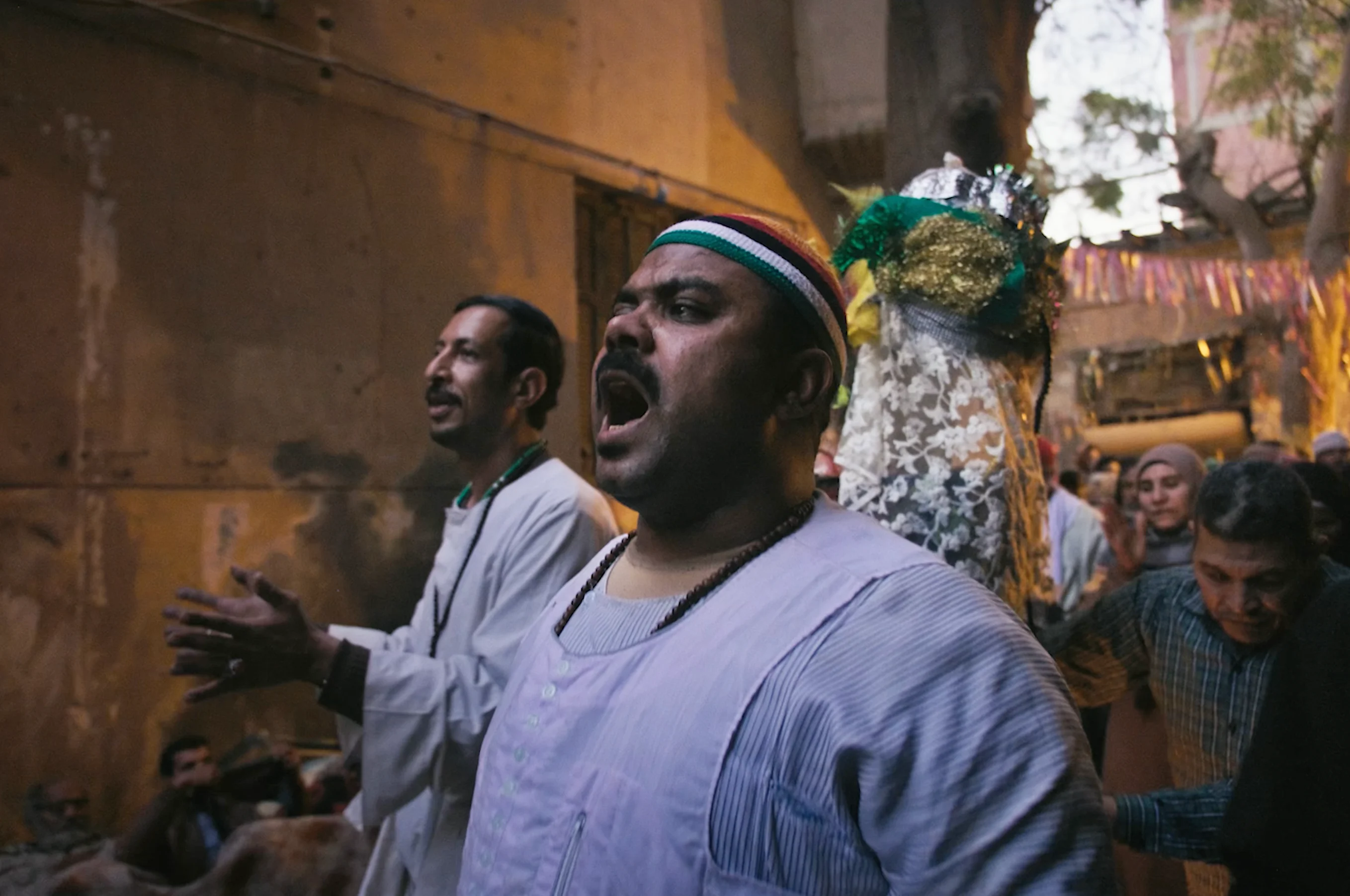
“There’s around twelve locations all around Egypt—right on the border of Sudan, places around the Delta, the South, some in Upper Egypt,” Mardini says. We move with his footage through the celebrations of many saints, including Sayyeda Zeinab, Sayyid Hussein, Sayyeda Nafisa, Sayyid Badawy and Sidi Abu al-Hassan. Filming over multiple years, he captures the moment the outside dissolves and the city seems to contract, all its fevered heat and noise siphoned inward. It is, in his framing, a space of communal release, an ecstatic gathering to exhale what ordinary life suppresses.
In one scene, a man swings intensely with his eyes closed, the melody working on him like invisible threads. When I ask Mardini which scene is memorable to him, it’s this one. “He’s swaying like he’s in some kind of trance,” he says, “overcome with the feeling.” He tips into release until a friend catches him with a casual, deft intimacy. Though, at the moulid, they could just as easily be total strangers.
In a scene from above the gathering takes form, resolving into a dense, circular congregation. Men, women and children swing in slow orbit; it’s not a circle that excludes but it does declare a centre. A small van edges through the liquid crowd, its progress dictated entirely by the bodies around it. A tambourine trembles in a wrist that also holds a cigarette, almost drowned out by surrounding clapping. In one of the film’s more tender moments, a young boy cups an elder’s face and presses a long kiss to his cheek.
It was a deliberate choice to go without music in the film, to avoid any stylized mysticism. “I was thinking a lot about the sound,” Mardini says. “I decided there couldn’t be any music because the praise and chants playing throughout the moulid were all a part of this experience, all intense in their own way. Creating something that makes sense out of all of these different moments was challenging. It was the most difficult edit I have ever done.”
Some of the chants come from old Islamic books of poetry developed in praise of saints, the prophet and God, while some freestyles remain supple to the spontaneity that moulid provides. “This is their expression, and to me, it’s an art form,” says Mardini. “It’s those artistic choices, the choice of music, the rhythm, that sets the overall experience. I am curious about how they express this sort of art direction in the moulids… Why do they use these color combinations? The more we observe, the more of these creative choices we see expressed.”
Mardini points to the hyperlocal traditions that surface, like women sharing henna paste and the dying of hands, and Mermah, popular in Upper Egypt, a competitive stick-fighting ceremony coinciding usually with the Mawlid Sidi al-Qenawi festivities. Both a martial art and a dance, it sees young men display centuries-old fencing techniques on horseback with a distinctive style for each tribe.
The moulid occupies a space that neither religious Sunni Muslim orthodoxy via Wahhabism, nor Western Orientalism can properly account for. Critics within the community see deviation, arguing it blasphemes and overstates the role of saints; essentially a shameful excuse to dance through the night till dawn. External eyes see an image of exotic chaos that soothes an orientalizing spectator who wants it to remain legible, mythical, a sand-coloured pastiche, rogue enough to be charmed by but still somehow safe enough to visit. Like all human experience, the moulid carries tensions that mirror reality itself. For as long as it endures, its contradictions will invite scrutiny from outsiders. But isn’t contradiction life’s driving undercurrent? Even faith does not stand apart from doubt; it is sustained through it, and made meaningful by its ongoing struggle against it.
El Leila al Kabeera doesn’t compensate for the moulid’s contradictions, nor does it package them for outside consumption. It is simply a rare event that ephemerally suspends the pressures of daily life. “Within our culture, there is so much stigma against it, and outside of our culture, it’s very fetishized, or gentrified,” Mardini says. “But it’s the only night of the year where men, women, families are moving together in public. Men are free to cry, they move their hips, dance, weep and express themselves. And it’s all in a public space. Sometimes, nothing will even be said. But it’s a creative expression all the same.”
But a threat gathers at the edges of this euphoria. A sweeping wave of demolition is moving through Old Cairo, flattening historic cemetery neighborhoods and destroying centuries of history archived within the necropolises that locals have made a living space. What the state frames as progress will see entire burial grounds being uprooted. “While the goal is to have better traffic downtown and in Old Cairo, it comes at the cost of the demolition of historic graveyards in which these moulids have existed for hundreds of years,” says Mardini.
Moulids have survived political shifts, religious debates, colonial intrusions and moral panics since the Fatimid era. They are older than most modern nation-states, than any ministry tasked with “managing” them or infrastructural demands now encroaching on them. “Moulids are like a therapy session,” says Mardini. “The moulid can be seen as catharsis, a form of therapeutic expression.”
The sound and collective movement of the moulid can ease dormant tensions held in the body. Long before modern psychology, Islamic philosophers like al-Kindi, al-Farabi, and Ibn Sina wrote about music’s power to recalibrate the soul, and Sufism deepened this approach with ideas around cosmic harmony, which even influenced therapies in early Islamic hospitals.
Mardini’s film conveys both the euphoric surge of the night and the emptiness that settles post. Mardini captures the moulid’s ability to reawaken a dampened sense of wonder dulled by the pressures of daily life. Perhaps it is less compelling to ask what the moulid gives than to notice what it relieves and takes away. “Those who come, they’re often working long days and nights,” says Mardini. “They have all this feeling being carried and stored inside of them. The moulid, really, is a place of release.”