
When Aisultan Seit was asked to exhibit at the Bukhara Biennial, he was initially uncertain about the theme: “Recipe for Broken Hearts.” The experience of losing a close relative, though, opened him up to exploring heartache. “Rukh,” his three-channel video work, captures the peculiar suspension of grief: the way it stops you in your tracks while the world appears to move forward around you. He tells Dalia Al-Dujaili how he showed that grief does not end, that we merely find a way to accept the chaos and uncertainty that comes with it.
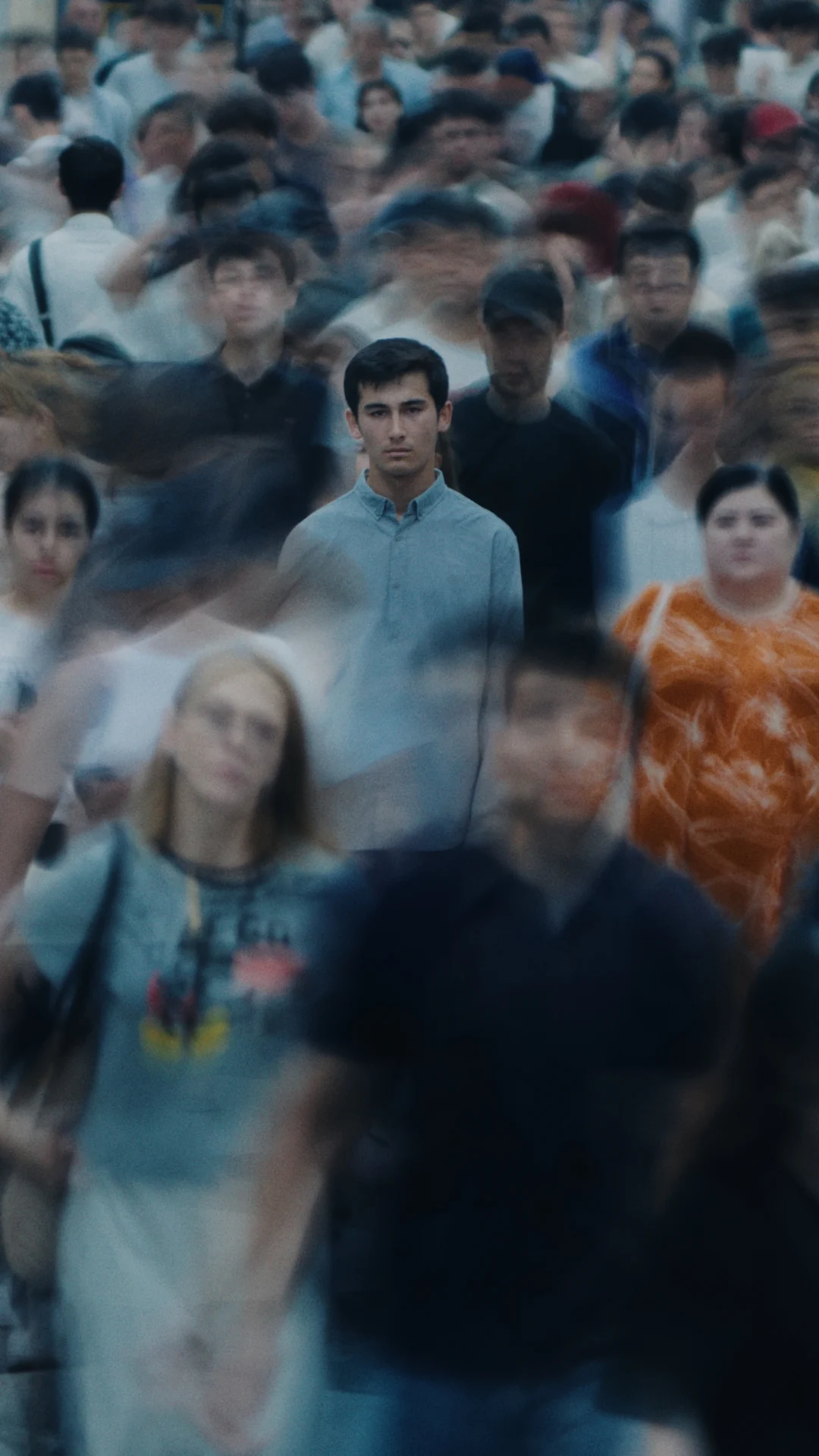
In Aisultan Seit’s three-channel video work titled “Rukh” (Arabic for “soul”), showcased at the Bukhara Biennial, Uzbekistan, this year, a young man seems to stand still whilst the world moves around him. When watching it, I am reminded of the way we feel when we lose a loved one—how the world seems to continue spinning although yours has definitively stopped. The work is inspired by Seit’s grief after the loss of a close relative, and is a move away from his regular film work though still very much reflective of the typical filmmaking arc: the first, second and third acts.
Seit began making music videos, self-taught, from 2017 with the likes of 21 Savage, and fashion films such as his short for Uzbek brand J.Kim, culminating in his debut feature film “Qas,” released theatrically in early 2023. That experience led to him getting in touch with several important artists, including members of the Kazakh Mata Collective, whose engagement introduced him to contemporary art as a serious, generative space rather than a peripheral interest, he tells me.
His involvement with the Tselinny Center of Contemporary Culture—initially as a filmmaker producing documentaries about artists—deepened his exposure to Central Asian contemporary art practices. This sustained proximity to artists and ideas eventually led, almost accidentally, to his debut as an exhibiting artist at the Bukhara Biennial, after curators responded to his fashion films.
The theme for this year’s biennial, “Recipe for Broken Hearts,” initially felt abstract to Seit, but the experience of losing a close relative led him to explore the idea of a soul that feels lost in grief; he characterizes this as the heartbreak. “My character is escaping something,” he says. “We come into room one and we see him escaping, he’s fading out from the space. But at first you’re not even understanding that he’s escaping—you just see this young man standing in the middle of nothing, or in the middle of everything. You start to translate it in your own way, and this is how the concept came: what is a broken heart? What is this experience?”
From Seit’s perspective, it’s a combination of mixed and complex feelings. One of them is this desire to escape, “but you don’t have enough courage inside of you to make a move or to make some sort of decision, because you’re stuck under your emotions.”
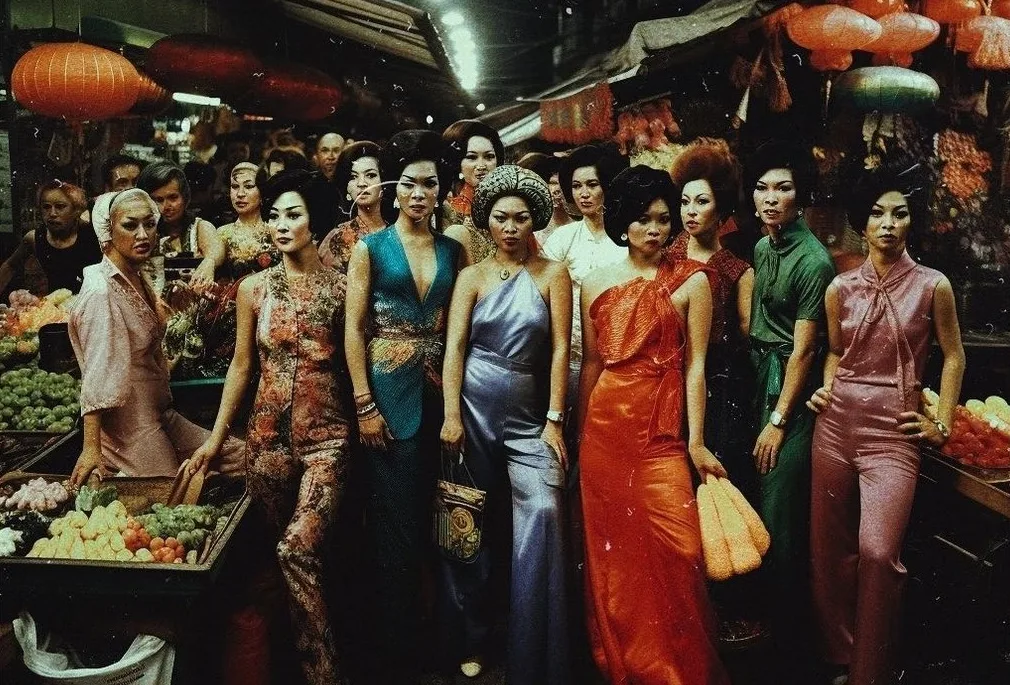
This is what the second room in the show serves—emotions. This channel is composed of archival footage from the Soviet-era film “No Fear,” directed by “one of the greatest Uzbek filmmakers” Ali Khamraev, from whom Seit took heavy inspiration. The original film was a pro-feminist propaganda work depicting women in Central Asia being encouraged to remove the hijab. Seit was struck by the range and intensity of male emotional expression within it: fear, cruelty, confusion, laughter, vulnerability. He deliberately recontextualizes these male expressions, extracting them from a feminist narrative and reassigning them to the emotional interiority of a man experiencing heartbreak.
This gesture operates on several levels: “I tried to express men’s expressions and emotions using a really feminist movie,” Seit says, “because in Central Asia, I don’t think we’re very rich in emotions, especially men—we usually keep everything inside.” “Rukh” allowed him to borrow an emotional vocabulary that does not conventionally exist for men in his cultural environment. The archival footage becomes an emotional proxy—expressing what his own character cannot articulate directly.
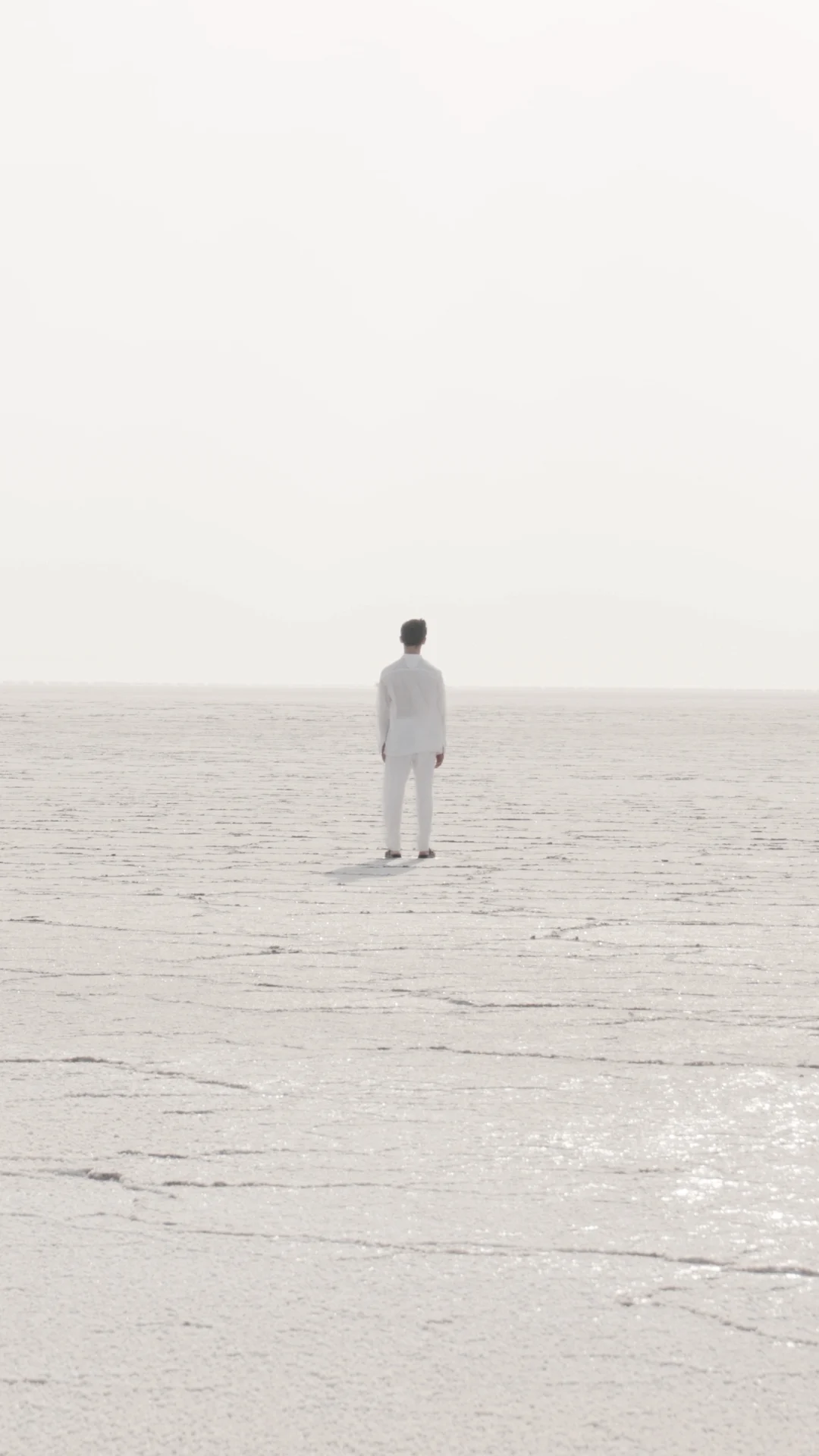
To visualize the soul drifting in an in-between realm, he chose to shoot in a ruined Soviet-era site of the Aral Sea, specifically Barsakelmes—a place marked by destruction, historical violence, and unresolved identity. Before the Biennale, Seit says his connection with Uzbekistan had been minimal, “I had visited Tashkent twice for shoots with Jenya Kim,” he says but as he began preparing the work, he started returning to Uzbekistan regularly. For this reason, he chose to film literally in-between the two countries, in southern Kazakhstan near the Uzbek border.
“Once an island in the Aral Sea, Barsakelmes became part of the mainland after the sea receded,” says Seit. “The Aral Sea was destroyed during Soviet times, and I find it really poetic, because I’m Kazakh and this was my first biennial. I wanted to have something relatable to both [Uzbek and Kazakh] cultures. The place itself looks very conflicted, so I tried to put my character into this kind of world.”
The third room of “Rukh” acts as a “resolution” to the conflict of the film work, although for Seit certainty and resolution are loose terms. A recurring theme for the filmmaker is faith, though he is careful to distinguish it from religious doctrine. The final chapter brings back elements of the first act—the world is spinning again, but things haven’t necessarily changed. The grief isn’t gone, it’s just loosened its grip. For Seit, faith is an acceptance of chaos and causality without rational explanation. The “resolution,” then, becomes less an ending than a door into accepting the uncertainty that grief presents us with.